When History Roars: The Simeone Foundation Automotive Museum Demo Day
There are museum visits that inform, and then there are experiences that move you — sometimes literally. On a bright April morning in Philadelphia, I packed my gear and made my way to the Simeone Foundation Automotive Museum for their April 11, 2026 Demo Day, themed “Carroll Shelby and the Rise of Professional Racing in America.” What unfolded over the next several hours was nothing short of a living history lesson, one told not in whispered docent tones but in the crack of throttle and the sweet sting of exhaust.
A Museum That Dares to Drive Its Cars
Tucked into an industrial stretch of Southwest Philadelphia at 6825 Norwitch Drive, the Simeone Foundation Automotive Museum doesn’t look like much from the outside. But step through those doors and you enter one of the most extraordinary collections of racing sports cars on the planet — over 75 historically significant machines assembled over five decades by the late Dr. Frederick Simeone, a renowned neurosurgeon whose other great passion was competition. In 2019, the Classic Car Trust named it the number one classic car collection in the world.
What sets the Simeone apart from virtually every other automotive museum isn’t just the quality of the cars. It’s the philosophy behind them. Dr. Simeone believed fiercely that historically important automobiles should not simply be preserved behind glass — they should be exercised, studied in motion, understood through sound and speed. That belief gave birth to Demo Days, and Demo Days are what make this place truly singular.
Scrutineering: The Calm Before the Storm
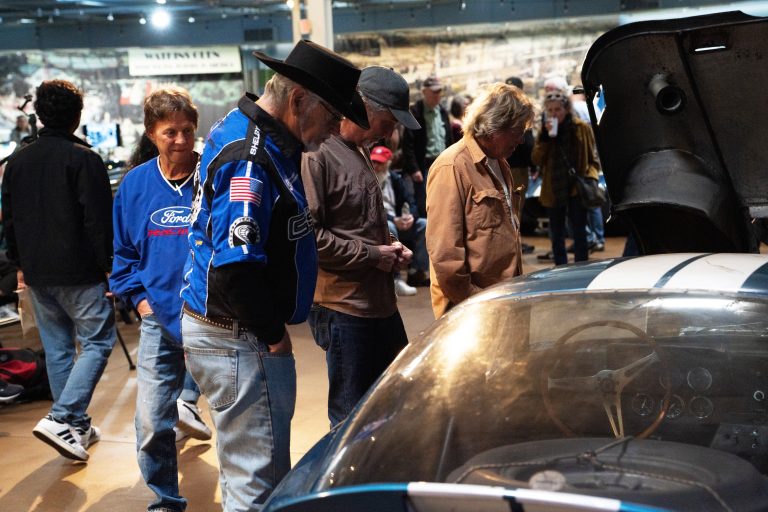
Demo Day begins at 11:00 AM with scrutineering — a 30-minute window during which the day’s featured cars are brought out for close inspection before they take to the museum’s three-acre tarmac out back. For a photographer, this is golden hour.
The April 11th lineup honored the legacy of Carroll Shelby, the lanky Texan who began as a racing driver and ended up reshaping American motorsport entirely. Five cars were selected for the day’s demonstration, and seeing them lined up together was a masterclass in the arc of one man’s influence on an era:
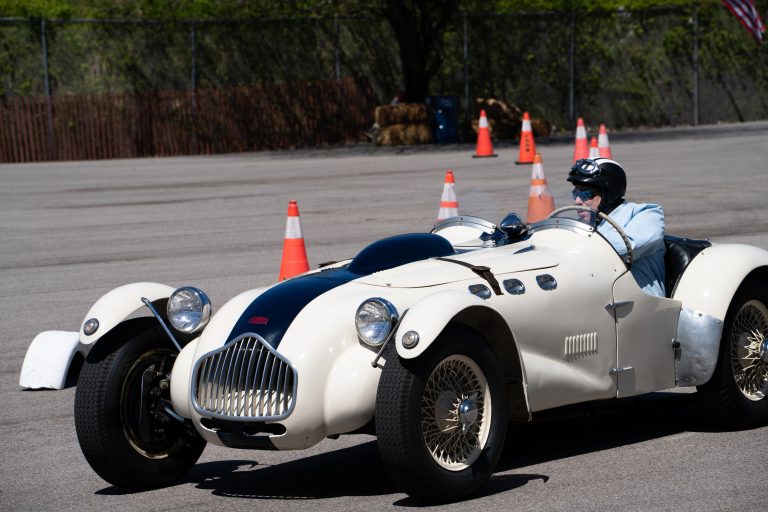
- 1950 Allard J2 — the car that launched Shelby’s driving career and gave American muscle a British chassis to call home
- 1954 Austin Healey 100 — elegant, wind-in-the-hair sports car racing in its purest form
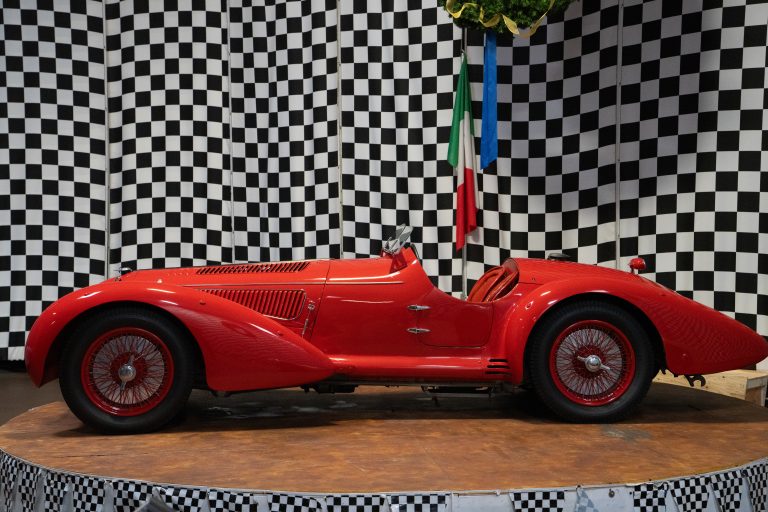
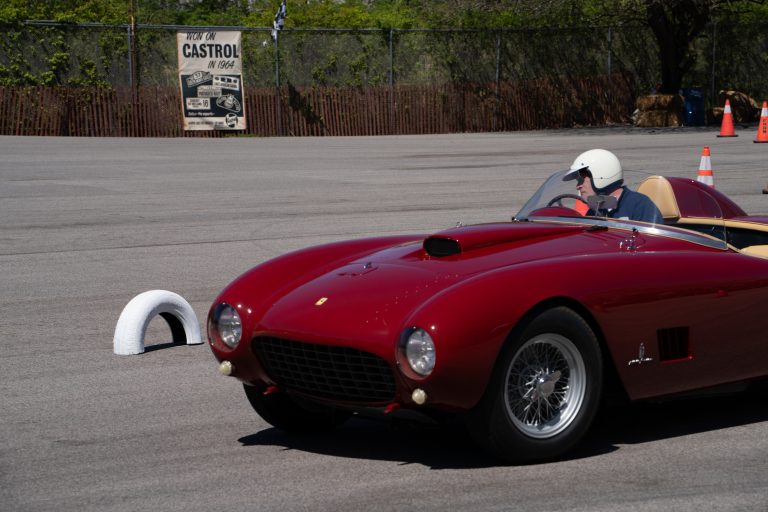
- 1954 Ferrari 375 MM Pinin Farina Spyder — a breathtaking work of Italian coachbuilding, dripping in racing pedigree
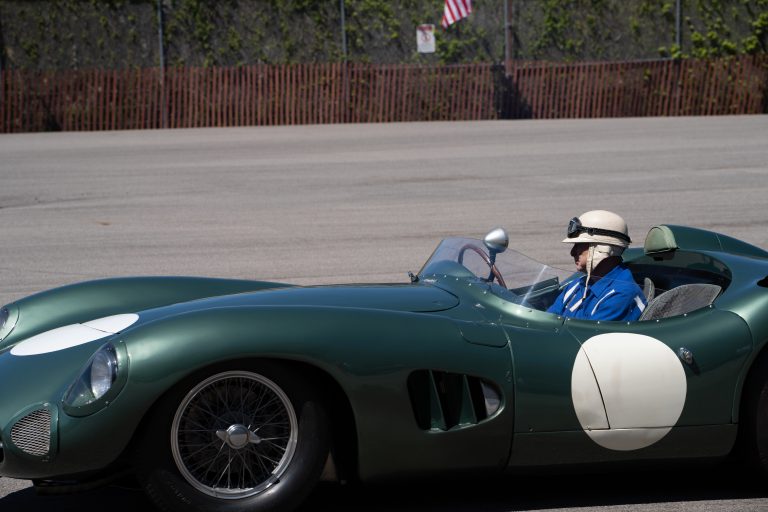
- 1958 Aston Martin DBR1 — the Le Mans winner that Shelby drove to glory in an era of giants
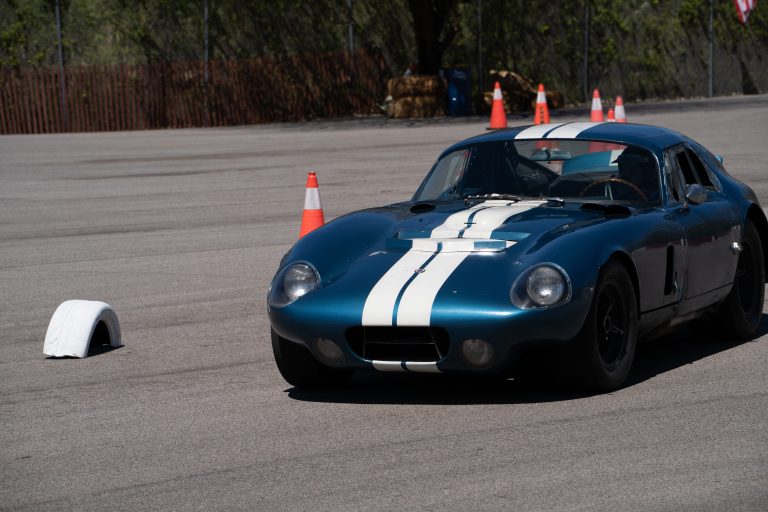
- 1964 Shelby Daytona Coupe — the crown jewel, the car that proved America could beat Europe at its own game on its own tracks
Standing next to the Ferrari 375 MM during scrutineering, studying the hand-hammered aluminum bodywork and imagining it sliding through Maranello’s test roads in 1954, is the kind of moment that makes you forget you’re holding a camera. Then you remember you’re holding a camera.
Carroll Shelby: The Man the Cars Tell
The formal presentation began at noon with historical commentary that brought Carroll Shelby’s story into sharp relief. This was a man who in the early 1950s was just another talented club racer, but who had an almost uncanny ability to coax speed and reliability from whatever machinery he climbed into. The Allard J2 was his proving ground — a brutish, effective combination of American V8 power and English chassis that helped Shelby earn his reputation as someone to watch.
By the late 1950s, he was driving factory cars for Aston Martin. The 1958 DBR1 at the Simeone is the very type of car in which Shelby co-drove to victory at the 1959 24 Hours of Le Mans, one of the most storied endurance races in history. Hearing its straight-six engine come to life in the parking lot behind the museum was, frankly, unnerving in the best possible way. The sound doesn’t so much fill the air as displace it.
Then came the Daytona Coupe. By 1964, Shelby had stopped racing and started building — and the Daytona Coupe was the result of his collaboration with designer Pete Brock to create an aerodynamic body over the Cobra’s mechanical platform. The goal was to beat Ferrari at Le Mans. And it worked. Watching the Daytona Coupe accelerate down the Simeone’s tarmac, low-slung and purposeful, you understand viscerally why it terrified Ferrari’s engineers.
Behind the Lens: What Makes Demo Day Special for Photographers
For photographers, Demo Days present a rare and wonderful challenge. The Simeone’s tarmac is not a racing circuit — it is a carefully choreographed demonstration space where cars are driven deliberately, at speeds that showcase character rather than flat-out performance. This is actually ideal for capturing the essence of a car rather than just its speed.
The April light at 12:30 PM was soft and cooperative, filtering through clouds just enough to eliminate harsh shadows without washing out the rich chrome and patina on these vintage machines. The Ferrari’s deep red coachwork practically lit itself. The Allard’s raw, no-frills brutality made for a different challenge — less glamour, more grit, and all the more compelling for it.
After the demonstration concluded, guests were invited to approach the cars directly for close inspection and photography. This is the moment most photographers wait for. No velvet ropes. No glass. You can crouch down and frame the Daytona Coupe’s vents against the sky, or get inches from the Aston Martin’s wire wheels and feel the heat still radiating from the brakes. That level of access at a museum of this caliber is genuinely rare.
Why You Should Go (and Bring Your Camera)
The Simeone Foundation Automotive Museum is open Tuesday through Friday from 10 AM to 6 PM and Saturday through Sunday from 10 AM to 4 PM. Demo Days are held roughly twice a month on Saturdays, with the presentation beginning at noon. General admission tickets cover Demo Day access, and the museum’s parking is free.
For photographers specifically: bring a lens with some reach for the tarmac demonstrations, a wide angle for the interior collection, and don’t skip scrutineering. The hour before the formal presentation — when the cars are simply there with a handful of fellow enthusiasts quietly circling them — is as close to a private audience with history as most of us will ever get.
The Simeone is not a flashy museum. It does not need to be. Its collection speaks with the authority of authenticity, and its Demo Days speak with the authority of internal combustion. On April 11, 2026, the remarkable cars presented told the story of one remarkable man, and we were there with our cameras to bear witness.
Some days, this is exactly the job.
More images from the demo day online at https://portfolio.artimagined.photo/Events/Simeone-Foundation-Automotive-Museum-Demo-Day
BOOK US: Voice Mail: 484-469-0288 | [email protected] | Based in Lansdowne, PA
Member of The National Press Photographers Association
Copyright 2024 © All rights reserved. Images may not be used without prior permission or purchase.